
Guide · 9 min read
How to test Facebook ads before launching them
By Pavan, Founder, FirstReaction · Updated
Short answer
Test a Facebook or Instagram ad before launch in five steps: study what already runs in your category in the Meta Ad Library, check the creative against a short checklist, simulate how your target audience reacts with an AI tool, live-test only the best two versions, then scale the winner.
Why test an ad before it goes live?
Running an ad is the most expensive way to find out it doesn't work. Meta's delivery system needs data before it settles: an ad set stays in the learning phase until it gets about 50 optimization events (purchases, sign-ups, or whichever event you chose) within a week. Every version you test live needs its own share of that budget.
The arithmetic gets heavy fast. If a sale costs you $30, getting one ad set out of learning costs around $1,500 a week. Test six ideas live and most of that money goes to ads you will switch off.
Splitting a small budget across many ads doesn't fix it either. When we ran our own first Instagram campaign in October 2026, with six ads in one ad set, Meta spent ₹1,507 of the first ₹2,534 (about $30) on one ad and ₹6 on another. Two days in, we had two landing-page views and no real answer about five of the six ads. That's normal: Meta optimizes for results, not for a fair test.
Pre-launch testing moves the cheap decisions earlier: which ideas are weak, what holds the good ones back, and which two deserve real money.
How do advertisers test ads today?
| Method | What it tells you | Cost and time | Main catch |
|---|---|---|---|
| Gut feel or a team review | Whether the ad looks right to people who know the product | Free, minutes | You are not the audience |
| Meta Ad Library research | What competitors run, and keep running | Free, 30 minutes | Shows what runs, not what works |
| Ads Manager preview | How the ad looks in each placement | Free, minutes | Says nothing about reactions |
| Asking ChatGPT or Claude | A general critique of the ad | Free or a subscription, minutes | Answers change from chat to chat, with no fixed audience to compare versions against |
| AI audience simulation | How defined buyer types react to each version, with reasons and fixes | Low, about a minute per ad | A prediction, not a measurement |
| Small live test | Real clicks and costs | Real budget, days | Small samples are noisy |
| Meta A/B test | A controlled answer between versions | Real budget, a week or more | Expensive for every version you add |
None of these is enough on its own. The pre-launch methods are fast and cheap but predictive; the live ones are real but slow and expensive. The workflow below uses each one for what it's good at.
A 5-step workflow to test an ad before launch
1. Study what is already running
Open the Meta Ad Library, set the country, and look up your category and your three to five closest competitors. Filter to active ads, and note:
- Formats they lean on: single image, carousel, short video, creator-style (UGC) video.
- Hooks: the first line of text and the first second of video.
- Offers and proof: discounts, reviews, press mentions, guarantees.
- Ads that have run for months. Brands rarely keep paying for an ad that loses money, so a long-running ad is a useful hint (not proof) of what works.
2. Check the creative against a checklist
Look at the ad on a phone, at feed size, and ask:
- Can you tell what the product is in under a second?
- Is there one clear message, or three competing ones?
- Is every word on the image readable at phone size? Is there less text than you think?
- Can you back up every claim: ratings, "best-selling", numbers?
- If the product is expensive, does the ad give a reason it's worth the price?
- Does the call to action match the page it links to?
Then check every placement's preview in Ads Manager. A square image that works in Feed can lose its headline in a 9:16 Story or Reel.
3. Simulate how your audience reacts
Most teams skip this step, because until recently the only options were focus groups and live tests. AI audience simulation fills the gap. You describe who you sell to; an AI builds a set of realistic buyer types (archetypes) from that description; and each one reacts to your ad: whether it would stop scrolling, what it thinks, whether it would click, and why.
There is early research behind the idea. In a Harvard Business School working paper, Brand, Israeli and Ngwe asked GPT survey-style questions as a shopper and found its willingness-to-pay estimates were realistic in size and consistent with economic theory. It is still a prediction, so use it as a fast first filter, not a final verdict.
To get useful results:
- Describe the audience the way a media buyer would: who, where, what age, what they care about, how warm they are (cold, warm, retargeting) and what makes them hesitate. "Women 25–55" is too thin. "US women 25–55 who shop home decor online and check reviews before a $300 purchase" is useful.
- Keep the audience fixed while you compare versions, so a change in score comes from the ad, not the audience.
- Run each version more than once and average the results. We use three runs per version for anything we publish.
- Read the reasons, not just the scores. The most useful output is which buyer type drops out, and why.
You can do this in FirstReaction, which is built for it: you save the audience once and reuse the same archetypes for every version, and you get scores per archetype plus a ranked list of fixes. It's free to start with 25 credits, and a simulation costs 1 credit (see pricing). A detailed prompt in a general chatbot also works and costs nothing extra, but its answers change from chat to chat and there's no saved audience to compare against. Our methodology page explains how a FirstReaction simulation is built.
4. Live-test only the best two versions
Take the two strongest versions into a real test, with one change between them: the image or the headline, not both. Use Meta's built-in A/B test when you need a clean answer, or two ads in one ad set when a direction is enough. Give it enough budget and days to leave the learning phase before you call a winner.
5. Scale the winner and repeat
Move budget to the winner and put the next round of creatives through the same steps. Ads wear out, so a steady flow of tested creatives matters more than one perfect ad.
Example: testing a $325 blanket ad before spending
Here is the workflow on a real, live ad. We took a Lola Blankets ad from the Meta Ad Library (a Refinery29 feature with a reader quote), described its likely buyers, and simulated it on FirstReaction.
Real simulation
Lola Blankets: The Original Lola faux fur blanket ($325)
Audience: US women, 25–55, cold audience, who shop home decor and gifts online. A $300+ blanket is a considered purchase: they check reviews and want to know it's worth it.
Live Meta ad from the Ad Library, running since 15 Aug 2026. Simulated on FirstReaction, 31 Oct 2026; scores are the average of 3 runs per version, on a 0–100 scale.
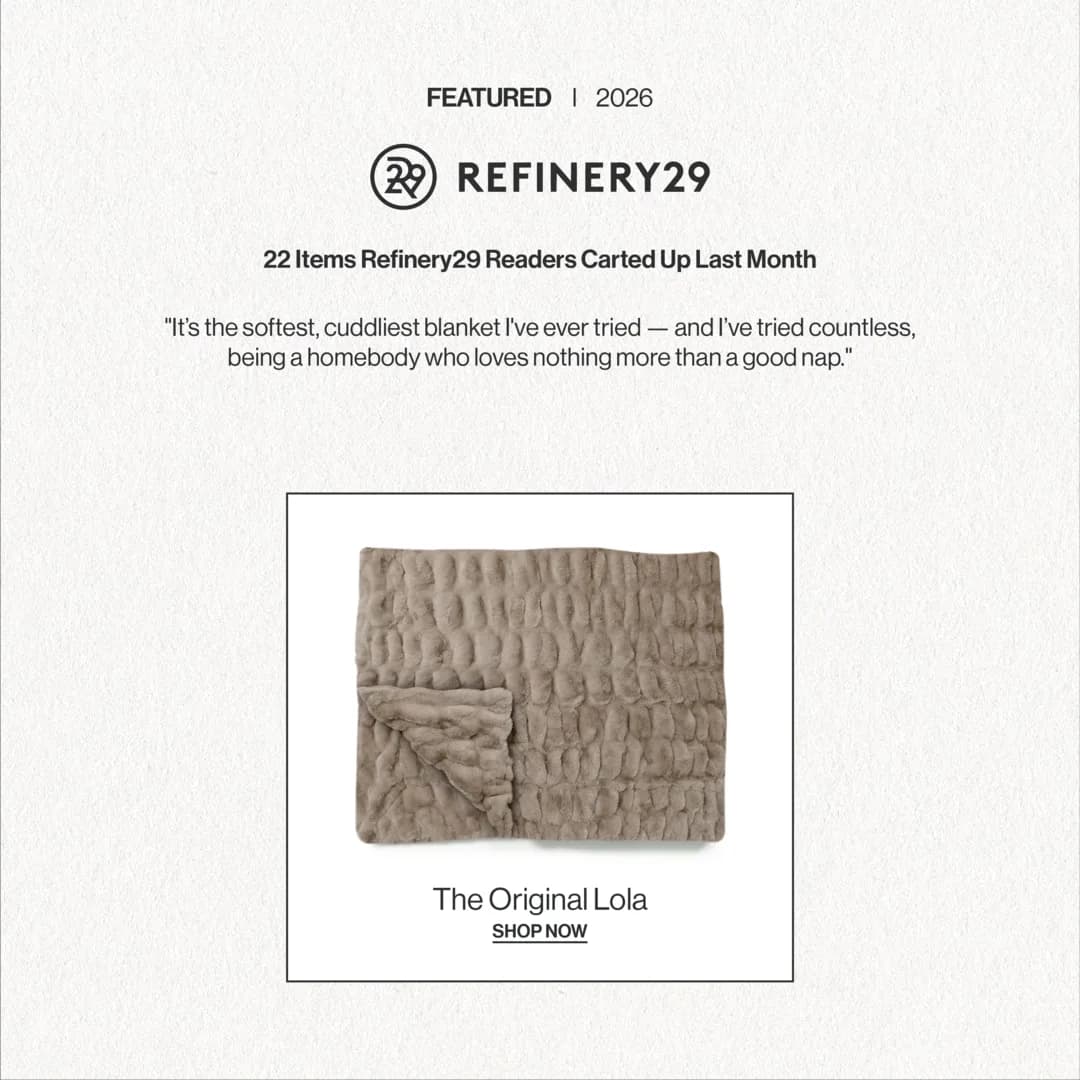
Original (live ad)
Shop Lola Blankets
Find out why everyone's obsessed
- Likelihood to act
- 39
- Engagement
- 56
- Scroll-stop
- 63
- Image score
- 61
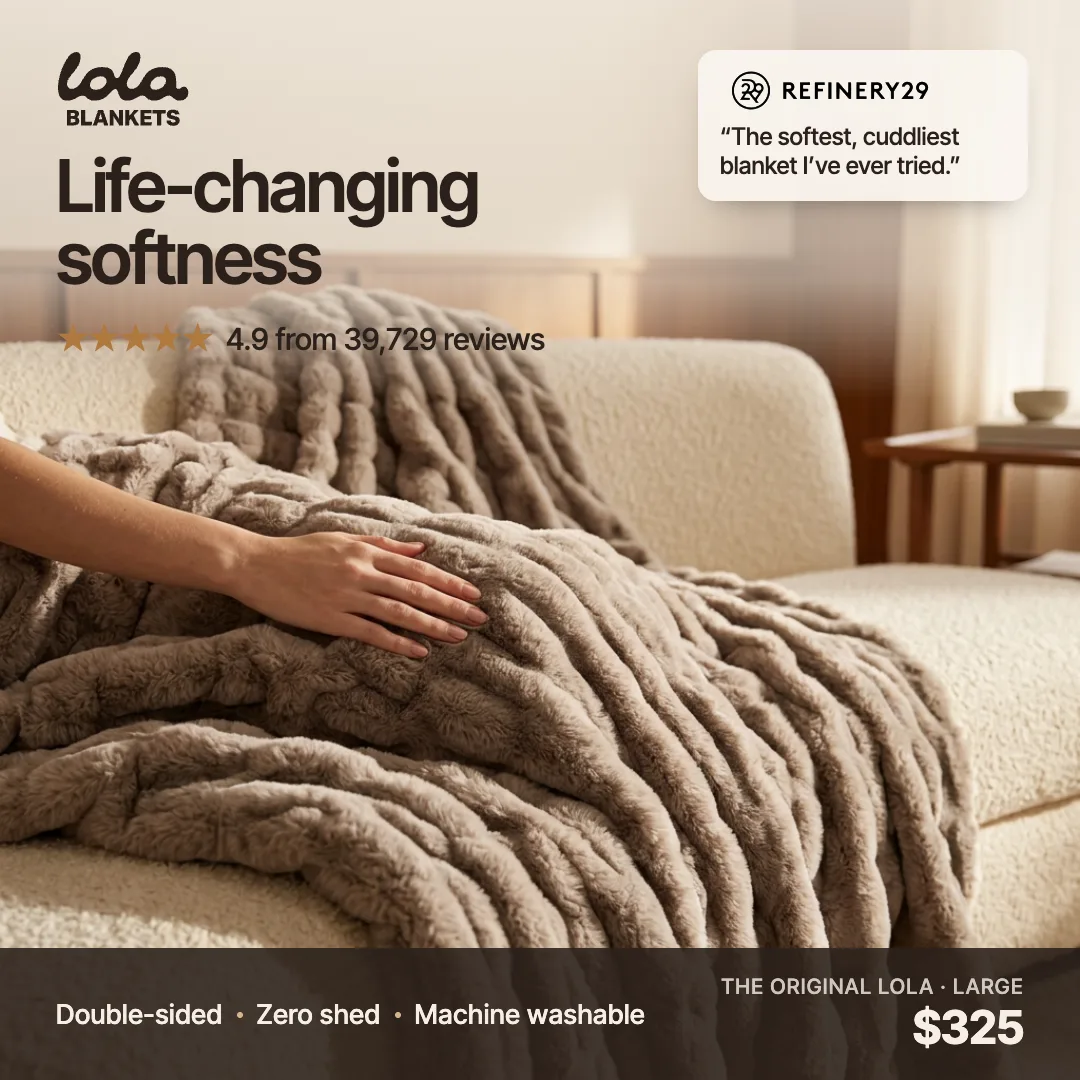
Optimised (rebuilt from the suggestions)
Life-Changing Softness
The softest, cuddliest blanket Refinery29 readers have tried. Double-sided, zero shed and machine washable. Rated 4.9 from 39,729 reviews.
- Likelihood to act
- 60
- Engagement
- 71
- Scroll-stop
- 71
- Image score
- 73
| Archetype | Before | After | Change |
|---|---|---|---|
| Discerning Decorator | 38 | 64 | +26 |
| Thoughtful Gifter | 36 | 60 | +24 |
| Cozy Comfort Seeker | 53 | 73 | +20 |
| Value-Driven Splurger | 20 | 40 | +20 |
| Trend-Curious Home Enthusiast | 48 | 62 | +14 |
Likelihood to act, per archetype.
What worked
- A trusted Refinery29 feature as third-party proof
- A reader quote that sells the softness
- A clear look at the blanket's texture
Where it lost people
- No reason a $325 blanket is worth the price
- A headline that only says “Shop”
- Text-heavy image that never shows the blanket in a home
What it suggested
- Show the blanket at home, with less text on the image
- Use a headline that sells the softness
- Give a reason it's worth the price: ratings, durability, care
Scores are predictions from a simulated audience, not real campaign results. Not affiliated with Lola Blankets.
The diagnosis was specific. The press feature and the quote worked. But nothing in the ad explained why a $325 blanket is worth it, the headline only said "Shop", and the image never showed the blanket in a home. The lowest score came from the buyer type who most needs that reason: the Value-Driven Splurger, at 20 out of 100.
We rebuilt the ad using only those suggestions, and only claims from Lola's own product page: a lifestyle photo, "Life-changing softness" as the headline, the 4.9-star rating from 39,729 reviews, and three practical features. Simulated again against the same audience, likelihood to act rose from 39 to 60, and all five buyer types moved up. The Value-Driven Splurger doubled, from 20 to 40.
Two things stand out. The biggest gain came from answering an objection, not from a flashier image. And the predicted share of people who stop scrolling barely changed; what changed was whether the people who stopped wanted to buy. The next step would be a live test of this version against the original.
Where pre-launch testing falls short
Used as a filter before a small live test, not instead of one, pre-launch testing cuts the number of ideas you pay to learn about.
Pre-launch checklist
- Researched competitors' active ads in the Meta Ad Library.
- Checked the creative on a phone, in every placement, against the checklist above.
- Simulated each version against the same specific audience, more than once.
- Fixed what held the best versions back, and simulated again.
- Live-tested only the top two, one change apart.
- Scaled the winner and started the next round.
Frequently asked questions
Can you test a Facebook ad without spending money?
Partly. Researching competitors in the Meta Ad Library, checking previews in Ads Manager, getting feedback and running an AI audience simulation all cost little or nothing. They tell you which version is most likely to work and why. Only real spend gives you real click-through and conversion numbers, so keep a small live test for the final one or two versions.
How much budget do you need to test a Facebook ad live?
Enough for each ad set to get out of Meta's learning phase, which Meta puts at about 50 optimization events in a week. If you optimize for purchases and a sale costs you $30, that is roughly $1,500 a week per ad set. Testing fewer versions live is the cheapest way to cut that cost.
How accurate is AI ad simulation?
Treat it as a strong first filter, not a forecast. It is best at comparing versions of an ad against the same audience and explaining what holds each one back. It can't see the ad auction, your landing page or the season, so the final call still comes from a live test.
What should you test first: the creative, the copy or the audience?
The creative. The image or video decides whether people stop scrolling at all, and Meta's delivery leans on the creative to find buyers. Fix the creative first, then the headline and primary text, then test audiences.
Does the same process work for Instagram ads?
Yes. Facebook and Instagram ads are bought in the same Meta Ads Manager and use the same delivery system. Check each placement's preview (Feed, Stories, Reels), because text that fits a square feed image can be cut off in a 9:16 Story.
How long does pre-launch testing take?
Research and creative checks take under an hour. An AI simulation of an image ad takes about a minute in FirstReaction, which is free to start with 25 credits and no card. A live test needs several days at least, so you want only your strongest versions in it.
Sources
Related guides
- How to test Meta ad creatives with AIWhat AI can read in a Facebook or Instagram ad, four ways to test creatives with AI, a step-by-step method, a prompt for any chatbot, and a real before-and-after holiday ad.
- How to validate ad creatives on a small budgetHow to test Facebook and Instagram creatives when you can't afford to test everything live: free checks, a run/fix/kill framework, a $10–$20 a day plan, and the real numbers from our own small campaign.
- What is AI audience simulation in advertising?How AI audience simulation works for Facebook and Instagram ads, what the research says about simulated buyers, a real example with five buyer types, and where it falls short.
- FirstReaction.ai vs A/B testing for Facebook and Instagram adsFirstReaction.ai simulates how your audience reacts to an ad before launch; an A/B test measures real results after you pay to run it. What each tells you, what each costs, and how to use them together.